2027 Is Coming: Ten Things The Economist Thinks Will Shape the Year
AI-assisted summary based on reporting fromThe Economist (The World Ahead).About our reporting
Key Points
- •From Trump's legacy battles and French elections to AI debt and orbital data centers, here are the ten defining trends The Economist expects to shape 2027.
Listen to this story (Audio briefing)
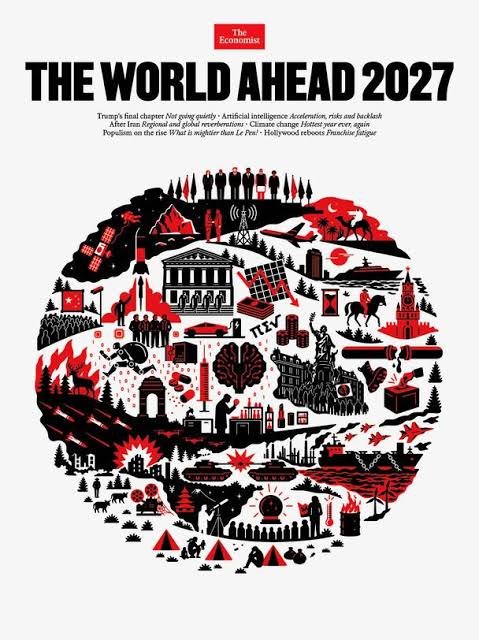
Every November, The Economist publishes The World Ahead, its flagship annual forecast examining the global trends, geopolitical fractures, and technological shifts on the horizon. While long-range forecasting is an imperfect art, the release is closely scrutinized across capitals and trading desks because it reveals what institutional leaders are genuinely anxious about—and where they see unexpected opportunities.
This year's edition carries an unmistakable undertone: the global order is approaching simultaneous friction points from several directions at once. Here is a breakdown of the ten defining themes, and why each one matters.
The Trump era starts to end, loudly
Tom Standage, the magazine's editor, argues that the post-Trump era is already getting underway—though it will be anything but quiet. With Democrats widely favored to regain ground in Congress, the forecast suggests Donald Trump will respond with heightened combativeness rather than compromise. Expect an onslaught of executive orders, protracted judicial battles, and aggressive unilateral actions to cement his legacy before his term expires.
Meanwhile, the scramble to succeed him will begin in earnest, forcing allies and adversaries alike to recalibrate what post-Trump American leadership will look like. Standage's vivid shorthand for this phase: a "destructive Angry Bird." Whatever one's politics, an administration operating against a ticking clock and preoccupied with legacy is inherently difficult to forecast.
The Iran war's long shadow
The Economist contends that the geopolitical fallout from Middle Eastern conflicts has left traditional allies less trusting of Washington, while adversaries appear less deterred. Beyond diplomacy, the economic reverberations are directly measurable: vital shipping lanes remain congested, energy transit corridors are vulnerable, and global fertilizer supplies are tightening.
When fertilizer inputs spike or dwindle, the pain manifests months later in diminished crop yields. The resulting food inflation and supply strain will inevitably hit developing economies hardest, far from the capitals where policy decisions are made.
Another record-hot year
Meteorologists anticipate another punishing sequence of prolonged droughts, severe wildfires, and record-setting summer temperatures. Yet the report identifies an unexpected paradox: erratic fossil fuel policies and geopolitical volatility have paradoxically strengthened the case for clean energy.
When oil and natural gas markets experience sharp, volatile swings, solar, wind, and battery storage stop being viewed purely through the lens of climate altruism. Instead, energy independence and price predictability have made renewables an urgent matter of domestic economic security.
The AI backlash
Of all the risks highlighted, the shifting sentiment around artificial intelligence deserves the closest scrutiny. Rather than speculative existential threats, The Economist points to an impending financial reckoning: capital-intensive AI ventures taking on unsustainable debt structures through complex, opaque financial arrangements.
Notably, the magazine pushes back against widespread anxieties that automation is about to erase the workforce overnight or exhaust the global power grid. The primary near-term hazard is a financial hangover, paired with rising public hostility toward Big Tech as users grow weary of tools being imposed upon their digital lives rather than solving tangible problems.
Le Pen and the French question
Across the Channel, the central European question is whether Marine Le Pen can finally capture the French presidency. An Élysée victory for the National Rally would send shockwaves through Brussels. The Franco-German engine that underpins European policy would stall, and sovereign bond markets would react swiftly given France's already strained fiscal trajectory.
The bond market gets its say
France is far from an isolated case. Major advanced economies have accumulated unprecedented debt burdens during years of cheap money, and the return of higher borrowing costs is exposing structural vulnerabilities. The Economist offers a straightforward warning: sovereign borrowing on this scale cannot expand indefinitely, and a market correction is eventually unavoidable. Sovereign debt markets typically appear stable until confidence abruptly cracks.
Taiwan's dangerous year
Western intelligence has long cited 2027 as Xi Jinping's benchmark for the People's Liberation Army to possess the military capability to seize Taiwan. While an operational capability deadline is not an order for invasion, the milestone itself significantly elevates geopolitical tension across the Indo-Pacific.
Crucially, modern battlefield dynamics in Eastern Europe and the Middle East offer a counterweight: inexpensive, distributed, and autonomous technologies have dramatically raised the cost for large powers attempting to overrun smaller, well-prepared defenders. Military strategists in Beijing are undoubtedly digesting those exact lessons.
The Ozempic effect
GLP-1 receptor agonists are doing far more than altering personal health metrics. The widespread adoption of weight-loss drugs is sparking downstream shifts across retail, fitness, cosmetics, and packaged food industries as consumer habits transform.
Moreover, emerging clinical evidence suggests these medications carry systemic anti-inflammatory and cardiovascular benefits, prompting pharmaceutical giants to pour capital into serious longevity and preventive health research. It stands as one of the genuinely optimistic developments on the year's ledger.
Space gets cheaper
With SpaceX's Starship moving toward routine orbital flights and commercial space stations preparing for deployment, the cost-per-kilogram to orbit is poised for another steep drop. Plummeting launch costs alter the economic viability of ambitious infrastructure projects—including orbital data centers, a concept that sounded like science fiction only a few seasons ago.
Hollywood tries a reboot
From venerable franchises like Star Wars attempting to win back fatigued audiences to independent digital creators producing viral cinema on shoestring budgets, the entertainment industry is undergoing a seismic realignment. The Economist observes with dry irony that a cinematic story about an established superpower overwhelmed by nimble, low-cost craft and autonomous droids has rarely felt more relevant to current realities.
The Bottom Line: Fragile Money, Unpredictable Power
Synthesizing these ten forecasts reveals a consistent overarching dynamic: political leadership is becoming more erratic, sovereign balance sheets are increasingly fragile, and technological capability continues to outpace the regulatory frameworks designed to govern it.
Yet the magazine avoids outright fatalism. Accelerating renewable deployment, expanding access to orbital space, and genuine medical breakthroughs all provide tangible grounds for long-term optimism. None of these outcomes are preordained, and annual predictions rarely survive contact with reality unscathed. But if even half of these forces accelerate as expected, 2027 will be a consequential turning point.
Source: The Economist, "The World Ahead 2027" (published November 2026).
Related Stories in World Politics
More in World Politics →OpenSSL vulnerability identified in EVP_EncodeBlock
A buffer overflow vulnerability exists in the OpenSSL library.

Aaron Pierre discusses his future in the DCU
Aaron Pierre played Green Lantern John Stewart in the 2027 film Man of Tomorrow.

Apple reportedly developing AI agent for Mac computers
Apple is reportedly developing an AI agent for Mac computers.

Anthropic founders receive $2B in company IPO
Anthropic held an initial public offering priced at $83 per share.

Apple hiring engineers to develop new AI agent
Apple is recruiting engineers to build an AI agent.

Meta sells 3D movies on Quest headsets
Meta now offers more than 150 3D movies Movies can be bought or rented to watch in VR on Quest 3 and 3S headsets Titles are available in Meta's TV app including Avatar and Spider-Man: Far From Home.
Want to Work Remotely for US & Global Tech Companies?
400+ verified remote positions in AI engineering, cloud development, design, and executive leadership are hiring now worldwide. Fast-track direct application with guaranteed employer delivery.
Subscribe to Our Daily AI & Market Briefing
Get our curated daily news brief, clear market takeaways, and essential video dispatches delivered directly to your inbox.